A dropped remote, a shirt on a high closet shelf, or a soup can at the back of a cabinet can turn into an unnecessary strain. The best reacher grabber for seniors is not always the longest or strongest model. It is the one that matches the person's hand strength, reach needs, balance, and daily routine well enough to make ordinary tasks feel manageable again.
A reacher grabber is a simple daily living aid, but the wrong design can be frustrating. A heavy tool may tire the wrist. A jaw that does not close fully may miss small items. A handle that requires a firm squeeze can be difficult for someone with arthritis, weakness after a stroke, or limited finger movement. Choosing by use case, rather than by appearance alone, is the most practical approach.
What a Reacher Grabber Can Help With
Reachers extend a person's reach without requiring repeated bending, stretching, or climbing. They can be useful for older adults managing joint pain, limited mobility, back problems, balance concerns, or recovery after surgery. Caregivers also often keep one nearby for safer, faster help with everyday tasks.
At home, a quality reacher can pick up lightweight items from the floor, retrieve clothing from a washer or dryer, bring down pantry items, pull a blanket into place, or collect mail from a low porch step. Some models can also assist with dressing tasks, such as pulling up a waistband or reaching a shoehorn.
That said, a reacher is not a replacement for safe storage or hands-on assistance when it is needed. Frequently used items should still be kept between waist and shoulder height. The tool should never be used to reach over a hot stove, handle sharp objects, lift glass bottles, or retrieve heavy items from an unstable position.
Best Reacher Grabber for Seniors: Start With the Right Length
Length has the biggest effect on comfort and control. Most reacher grabbers fall into short, standard, and long options. The best choice depends on where the tool will be used and whether the user needs it while sitting, standing, or using a wheelchair.
A 24- to 26-inch reacher is often a comfortable everyday size. It works well for picking up items from the floor, reaching into cabinets, and grabbing clothing from a laundry basket. Because it is shorter, it generally offers better control and requires less hand effort to keep the jaw steady.
A 32-inch model can be a helpful middle ground for people who have trouble bending at all or who need extra reach from a seated position. It gives more distance without feeling as unwieldy as a very long model. For many seniors, this is the most versatile length for bedroom, kitchen, and living room use.
Longer reachers, often 36 inches or more, are best for high shelves, low storage areas, and users who rely on a wheelchair or recliner. The trade-off is leverage. The farther the object is from the hand, the heavier it feels and the harder it can be to position the jaws precisely. A long reacher is excellent for lightweight objects, but not necessarily for fine tasks such as picking up a coin or a pill bottle cap.
Choose a Handle That Matches Hand Strength
The handle is where comfort becomes usability. A senior with strong hands may do well with a traditional trigger-style grip. Squeezing the trigger closes the jaws, and releasing it opens them. This familiar design is common and works reliably for many general household tasks.
For arthritis, reduced grip strength, or hand pain, look for an ergonomic handle with a wide, cushioned grip. A larger handle can spread pressure across the palm rather than concentrating it in the fingers. Some reachers use a more gentle trigger action, while others offer rotating or contoured handles that reduce wrist twisting.
There is no universal "easy grip" design. A person with limited finger motion may find a trigger difficult even if it is padded. In that situation, a model designed for a whole-hand squeeze or a different grip angle may be more comfortable. If possible, consider the user's dominant hand, whether both hands are affected, and how long they will need to hold the tool during a typical task.
Look Closely at the Jaw and Tip Design
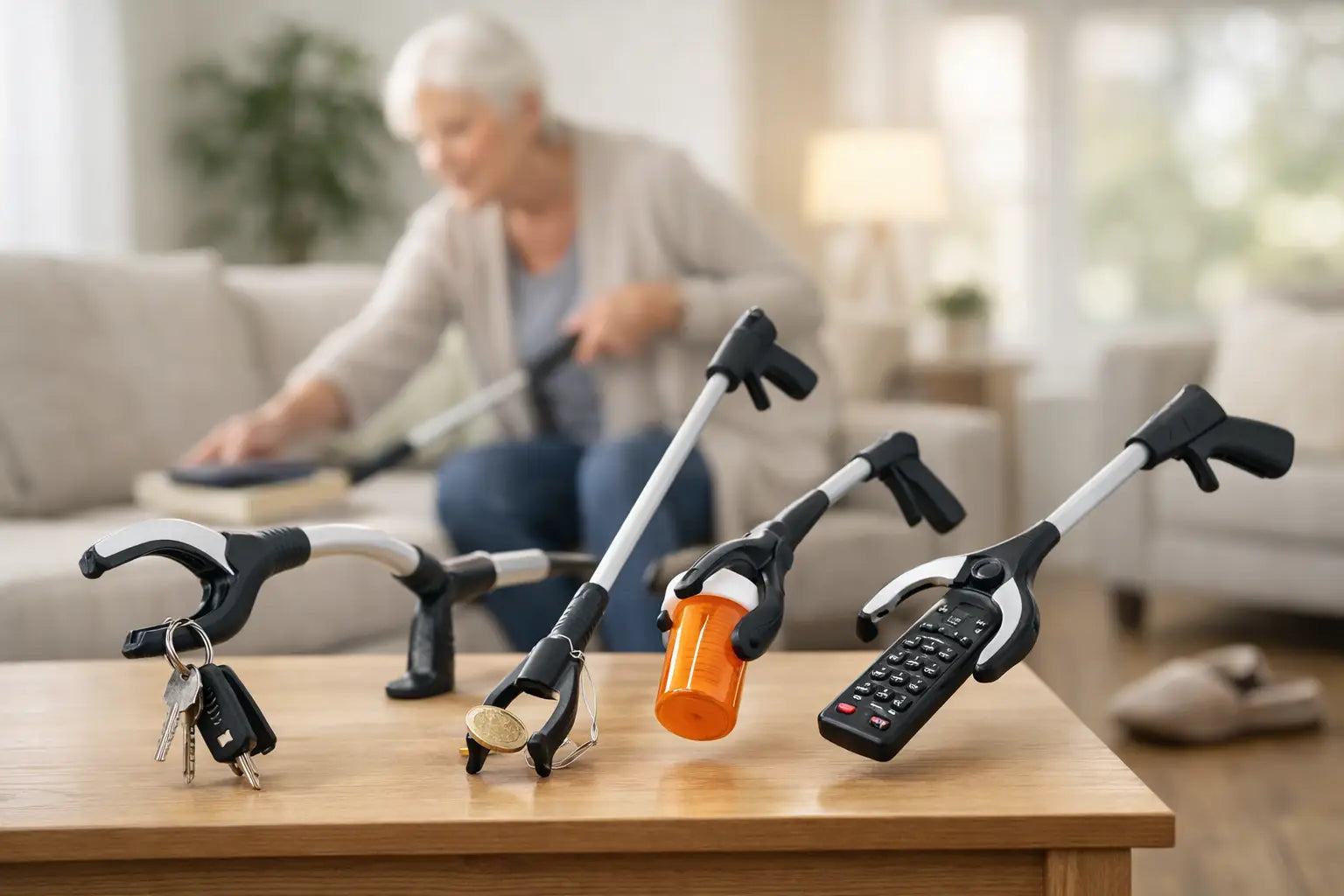
The jaws determine what the reacher can actually pick up. Wide jaws can make it easier to grab larger objects like a towel, newspaper, or boxed food item. Narrower jaws tend to offer more precision around small items and tight spaces.
Rubberized or silicone-coated tips are especially useful because they create traction. They help prevent objects from sliding out and can make it easier to pick up smooth items such as a phone, plastic cup, or television remote. Many well-designed reachers also have textured tips that grip fabric, paper, and lightweight containers more securely.
A rotating head is worth considering for people who have difficulty turning their wrist. It allows the jaws to be positioned vertically or horizontally while the user keeps their hand in a more natural position. This can help when reaching into a cabinet, collecting an item beside a chair, or retrieving something from the floor.
For routine household use, prioritize a jaw that closes evenly and firmly. A wide opening is helpful, but a reacher is only as useful as its ability to hold the item once it is picked up.
Weight Capacity Matters More Than Marketing Claims
Most reacher grabbers are meant for light household objects, not heavy lifting. Even if a product lists a higher weight capacity, the user's ability to control the object safely matters more than the maximum number on the package.
A reacher may handle a small water bottle, magazine, shirt, or lightweight canned good. It may not safely manage a full glass container, a large detergent bottle, a cast-iron pan, or anything that could cause injury if dropped. Long models are particularly prone to feeling less stable when used with heavier items.
A good rule is to use the reacher for objects that can be lifted comfortably with one hand and that will not create a hazard if they shift. When in doubt, ask for help or use a safer retrieval method. This is particularly important for seniors with balance limitations, osteoporosis, or recent surgery.
Features That Make Daily Use Easier
The most helpful features are usually practical rather than complicated. When comparing reacher grabbers, look for these details:
- A lightweight aluminum shaft that is easy to hold without adding strain
- Rubberized gripping tips for better traction on smooth and small objects
- A rotating head for reaching from different angles with less wrist movement
- A comfortable, non-slip handle sized for the user's hand
- A hanging loop or clip for keeping the reacher beside a bed, chair, or walker
A built-in magnet can help retrieve keys, pins, or other small metal items. It is a useful bonus, but it should not be the reason to choose a reacher. Reliable grip, comfortable handling, and appropriate length will matter far more in day-to-day use.
Match the Reacher to the Person and the Room
Many households benefit from more than one reacher. A shorter one near the bathroom or kitchen can handle close-range tasks, while a longer model beside a favorite chair or bed can reach the floor and nearby shelves. Keeping the reacher where it will be used prevents the ironic problem of needing to bend down to retrieve the reacher itself.
For a wheelchair user, consider seat height and whether the reacher needs to work beside the chair, in front of it, or at an angle from a seated position. A longer shaft and rotating jaw may be more useful than a standard straight model. For someone recovering from hip, knee, or back surgery, a lightweight reacher that works easily from a standing position can reduce repeated bending during the recovery period.
Caregivers should also watch how the person uses it the first few times. If the reacher causes leaning, twisting, or loss of balance, a different length or storage location may solve the problem. A practical aid should reduce effort, not introduce another challenge.
A Simple Test Before Relying on It
Before making a reacher part of a daily routine, try it with a few common items: a sock, a remote, a lightweight plastic cup, and a small towel. This checks whether the jaw can handle different textures and whether the user can operate the handle without discomfort.
Practice from a stable stance or while seated with both feet supported. Keep the object close to the body as it is lifted, and avoid reaching far to one side. If hand pain, dizziness, or unsteadiness occurs, stop and reassess the setup.
The right reacher grabber can support independence in small but meaningful ways. Choose a model that feels comfortable in the hand, works in the spaces used most often, and handles the everyday items that should never require a risky stretch or bend.